
November 2025: Something Old, Something New
Instead of a themed issue this month, a roundup of a few things we've been thinking about
Something old:
WHILE WE RECOGNIZE that publishers have a general horror of the old, there are many ways to make it new again. ArabLit Books’ publication of Samira Azzam’s Out of Time was an unquestionable success; we believe there is an audience for more work by authors — especially women authors — whose twentieth-century works were crowded out of the public sphere. Writers like Lebanese author Layla Baalbaki (read an excerpt from her extraordinary Spaceship of Tenderness to the Moon and her incisive short story “The Cat”); Tunisian novelist Aroussia Nalouti; and Syrian poets Da’ad Haddad and Saniya Saleh (read why Rasha Omran thinks you should publish Saleh’s work).
Indeed, when asked to recommend fellow Arab women writers, prominent Arab women writers often mentioned those from a previous generation.
For publishers who want a recognizable (old) name, Palestinian writer Ghassan Kanafani’s iconic short-story collection Land of Sad Oranges has not appeared in English (although the title story has), and we just published the charming title story from Palestinian writer Najati Sidqi’s The Millionaire Communist.
Something new:
WE RECENTLY FEATURED an excerpt from Zuhair Al Hiti’s new book A Nest of Embers, which explores Iraq’s Sabaen community and the dark side of village life, and we also reviewed award-winning Egyptian author Muhammad Makhzangi’s 2025 book, The Smell of the Sun. More on those below.
Something poetry:
THE SHARP-EYED, ORIGINAL Palestinian poet from Gaza Hend Jouda — whose poetry straddles the comic and serious, the banal and the transcendent — has a book available for translation to English, and we have already made a go of translating many of the poems. More on that below.
. . . . and another thing that’s new:
THIS MONTH, WE LAUNCH a Spanish-language website for Arabic literature in translation, ARABLITe.org, edited by the translator Danae Fonseca.
-MLQ.
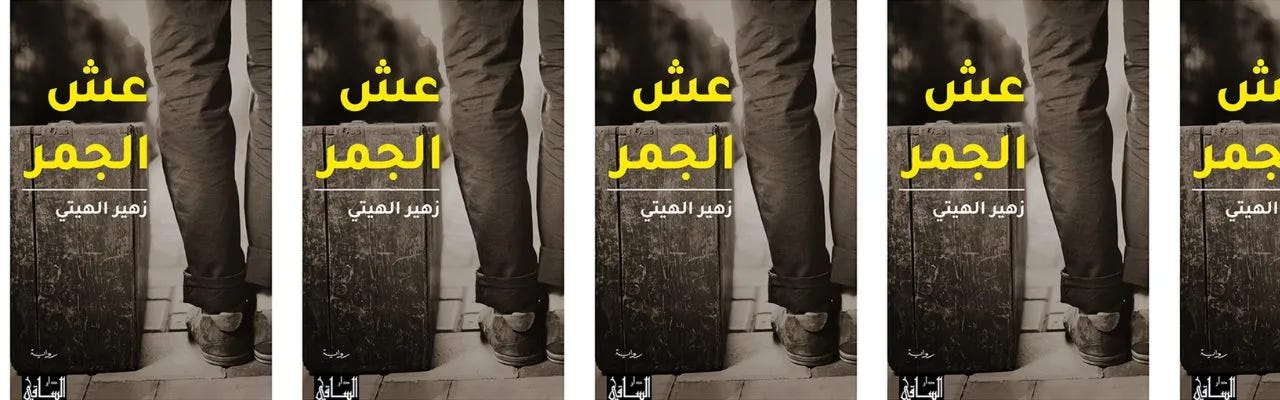
Featured (New) Fiction: Zuhair Al Hiti’s A Nest of Embers
ArabLit’s Iraq editor Hend Saeed has been working on assembling a list of diverse Iraqi stories; books that illuminate the many visions and versions of Iraq.
A Nest of Embers tells the story of Zafaran, a young man trying to escape the labels slapped on Sabeans, who leaves Baghdad hoping to find freedom in a small village. Yet, as soon as he arrives, he is recognized as the “Sabean,” and his life takes a new turn, such that he not only faces the myths about Sabeans but the village’s inner darkness.
Zuhair Al Hiti, an Iraqi writer and journalist, has published three novels; this is his most recent.
The excerpt we published, Chapter 5, opens:
The shadow of the girl in the damp morning air confused him. It lingered in his mind as he made his way to school on his first day, which passed without any major surprises, which was not how it had begun.
Zafaran did not expect that the nickname “Sabian” would stick to him in Kish from the very first day in school, triggering the rural community’s prejudices—the ones rooted in shared memory about this “mysterious” religion. These prejudices were coupled with cruel images and stories about the Sabian community, including claims that they choked birds before eating them, practiced magic, and supported the regime. There were also the accusations of extreme wealth and a variety of racist beliefs. So, Zafaran’s arrival in the village was no ordinary event. Everyone was curious about the Sabian. Women in particular were interested, since having a romantic relationship with an outsider was considered safer than dating a local in a place where everyone knew everyone.
Featured (Old) Fiction: Najati Sidqi’s Short Stories
Old short stories aren’t just enjoyable; they’re also an insight into cultural and political history.
Najati Sidqi’s Memoirs of a Palestinian Communist, translated by Margaret Litvin, Anas Farhan, and Gideon Gordon, is out this month from University of Texas Press.
His delightful short story “The Millionaire Communist” appeared in Sidqi’s 1962 short-story collection of the same name; it’s a satire that follows the story of a real-life fellow Arab Communist from Haifa who returned from Russia and got rich profiteering off a war-relief charity.
It opens:
I was on a plane to Egypt in early January when an investigative journalist sat down next to me. He was a frequent traveler, well read, an expert in people’s stories and temperaments. I noticed him turning toward the back seats when suddenly he grabbed my arm; I thought he was having a dizzy spell, and I almost rang the bell to call for the flight attendant, but he quickly stopped me and as he nodded toward a stocky man looking at the clouds from the window. He asked:
“Do you know that gentleman?”
“Not at all. Who is he?”
Featured Poetry: Hend Jouda
Hend Jouda is a Palestinian poet from Gaza — currently in France — whose most recent collection has also appeared in French translation. Born in the Bureij refugee camp in 1983, Jouda has published three collections: Someone Always Leaves (2013), No Sugar in the City (2017), and A Finger That Managed to Survive (2024).
We have published five of her poems on ArabLit but have a small collection translated by Alaa Alqaisi, M Lynx Qualey, and Layla Salma.
Read the five poems and send us a note if you’re interested in more.
ARABLITe: Arabic Literature in Spanish Translation
This month, we launch ARABLITe, a Spanish-language e-magazine of Arabic literature in translation.
ARABLITe, a partner site of ArabLit’s, will be run by Danae Fonseca, a postdoctoral researcher and lecturer at the University of Barcelona whose work focuses on Palestinian visual arts and literature, co-founder of “Llegir Palestina.” (More about Llegir Palestina: Making a Space to Read About Palestine.)
She write:
“My interest in ARABLITe stems from my belief that literature conveys memory, history, and imagination across borders,” Fonseca said. “I hope this platform can connect Arabic literary voices with readers in the Spanish-speaking world, honoring their diversity and expanding the pathways through which stories travel.”
Upcoming events
Read Palestine Week is set for November 29-December 5. Publishers who want to participate, please contact publishersforpalestine@gmail.com or info@arablit.org.
💰Grants, subsidies, & support
Don’t miss LEILA’s list of grants, subsidies, and support on their website.
The Sheikh Zayed Book Award offers a significant subsidy for shortlisted titles in the children’s and literature categories.
If you know of grants or subsidies targeting Arabic literature, please let us know at info@arablit.org.